
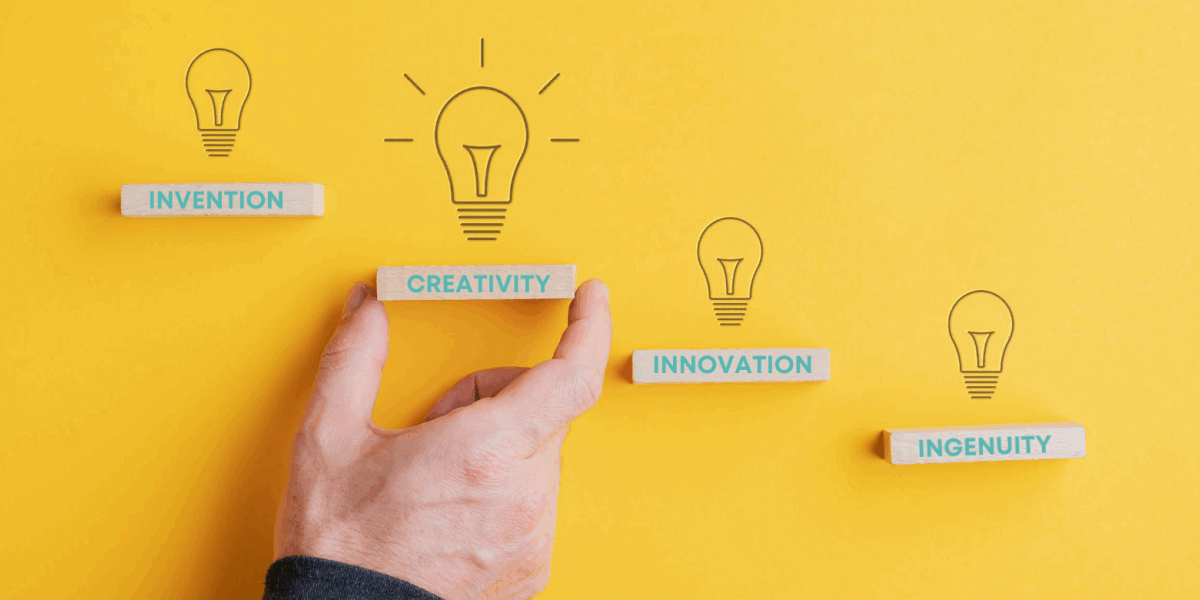
Four things to focus on during challenging times: invention, creativity, innovation, and ingenuity
Have you ever heard someone speak up in a group saying that they aren’t that creative? It’s an oddly self-deprecating statement. Now in the same sentence, replace the word creative with innovative. I bet you’ve never heard someone admit that. Everyone wants to be known as an innovator. There a certain cachet around the word that oozes success. But in reality, creativity and innovation are inextricably linked; they’re connected through big ideas and products of divergent thinking and problem-solving. Along with the closely related invention and ingenuity, creativity and innovation are the foundation for the most fundamental concepts in business.
When you generate new ideas, you’re creative.
When you take those creative ideas and turn them into products, services, or even experiences, you’re inventive because you’re designing breakthroughs that have never existed before.
When you determine the value of your new invention and what’s needed to move it forward to people and the world, all while devising processes to support a successful launch, that’s innovation.
Taking time to reflect on your innovations and evaluate exactly how they are doing by looking at available data and listening to what people have to say is ingenuity. After interpreting the results, that feedback will lead you to adaptation, improvement and refining your invention.
It’s these four skills that are going to help us get through today’s challenges with COVID-19. We’ve already seen how as the economy reboots, the playing field for businesses who are competing for a leg-up isn’t actually level. The rules as to which companies qualify for help quickly have successfully shut out entire categories because they operate differently as innovation exemplars.
The fact is that we’re living in a reality where established business models have been completely disrupted. Targets once used to guide success have been crushed. Most sectors that have reopened to date have seen increased expenses and been faced with consumers who are very wary of their spending because they are hurting too. Frankly, everyone is vulnerable and scrambling to hold on.
Of course, the buzz is that those who can innovate to pivot their businesses quickly will reap the benefits. But in reality, it’s the best innovators that have fallen through the cracks. Startups, the very hubs of innovation in the Canadian economy, who before the pandemic were able to receive investment capital funding coordinated through accelerator and incubator programs, are on the verge of collapse. Despite the government responses created at all levels, seriousness and urgency are growing unabated, inciting more concern each day.
In an article published in The Toronto Star this April, Krista Jones, one of the founders of the Momentum program at the MaRS Discovery District, raised the alarm and laid bare the massive problems start-ups are facing. While they are used to operating with inconsistent revenue streams and bucket loads of constraints, she argues that with the challenges they’re facing today, those operating realities that made them nimble, have largely excluded them from receiving any government aid. Jones goes on to state that with low economic confidence, the last sources of funding, investment capital, are “drying up,” which means that “without government action, they will fail” (Jones, 2020, para. 16). We can’t let that happen.
It’s important to recognize that inventiveness and ingenuity will also contribute significantly to helping resuscitate businesses and sectors hard hit during the pandemic and enabling them to pivot. We’ve seen sparks of this already. Look at the introduction of mask extenders, invented to offer more comfort for people who wear PPE for extended periods of time. While the predominant focus has been on products and services related to stopping the spread of the virus, perhaps not all inventions will happen in labs. Many restaurants are offering “market boxes” or “grocery bundles” as part of their online ordering offers to provide customers with another mode of simplifying shopping and saving them trips out in public. Invention and ingenuity rely on listening and observation to pick up on the pain points and retool innovations accordingly.
More government policy and programs have been developed in the past several months than usually take years to finesse. They’ve had to. It’s been creativity, invention and innovation that have enabled these to come online rapidly. Perhaps there’s still time for ingenuity to determine where large segments of the economy were missed. We need to take a page from the very companies hanging by a thread and embrace innovation to get them the relief they need. If we don’t, I am in full agreement with Krista – the government money may be for nothing.
After all, if we take a page from those very companies hanging by a thread and embrace inventiveness, creativity, innovation and ingenuity, we’re likely to reap the benefits for the long-term and help bring about a solid recovery.
Related posts

With ESG Backsliding – First Nations’ Values Provide Critical Leadership

Rediscovering Professionalism: Lessons from the Past for Today’s Leaders

Perfecting The Pitch: A Guide for Early-Stage Ventures

Unleashing the Secret Sauces of Entrepreneurship: Insights from the Kitchen to the Pitch

Seven Questions Every Board Member Should Ask About AI

Recent comments